Ashtanga: the eight limbs of Yoga
Patañjali's Yoga is structured in eight limbs. In Sanskrit: Ashtanga (aṣṭa, eight; anga, limb). It is not a progression of levels, nor eight independent techniques. It is a single discipline, described from eight angles.
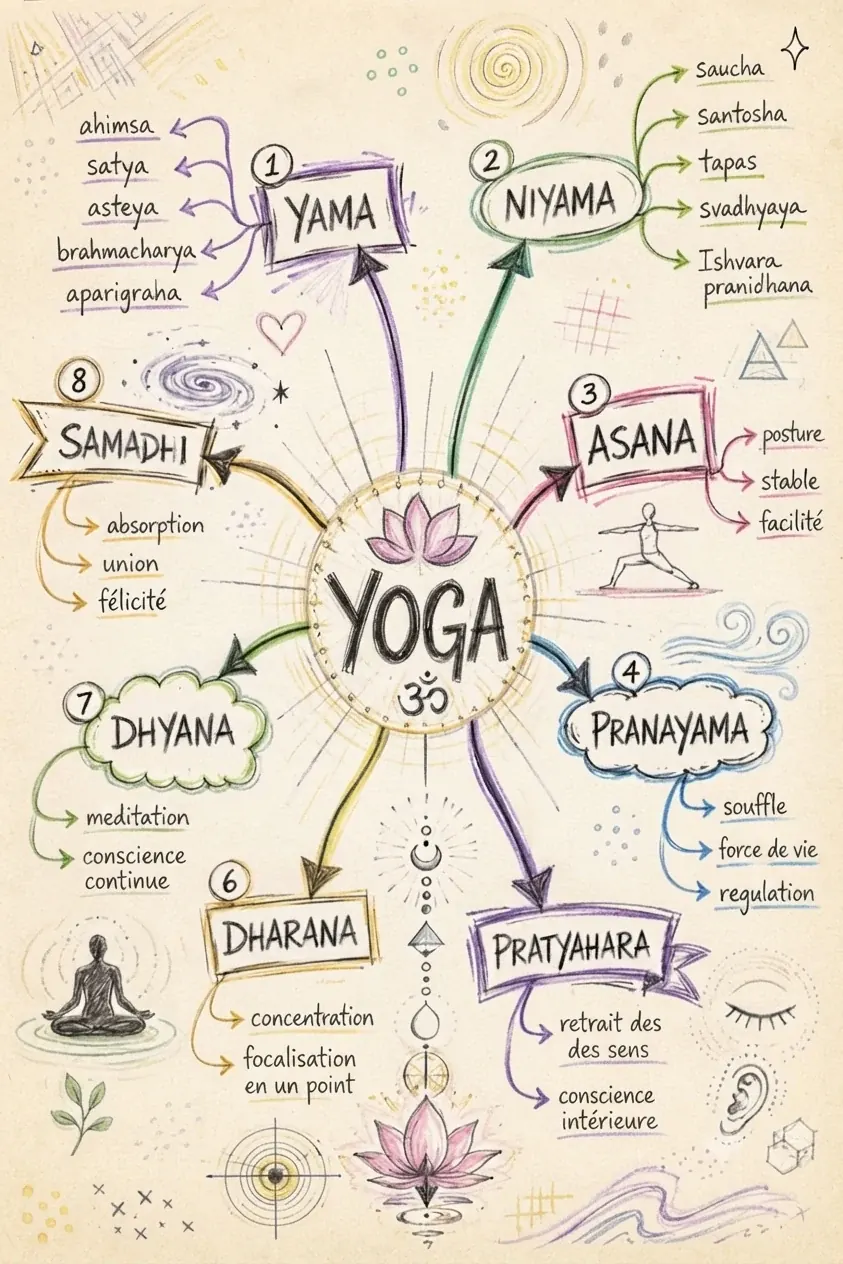
The eight limbs
- 1. Yama
-
Moral observances / Universal disciplines
Principles of moderation and ethical behaviour towards others and the outer world: non-violence, truth, non-stealing, continence, non-possessiveness.
- 2. Niyama
-
Personal observances / Individual disciplines
Rules of personal conduct and of a disciplined inner life: purity, contentment, ardour, self-study, surrender to the divine.
- 3. Asana
-
Posture / The seat
The physical postures of yoga, steady and comfortable, so that the body can remain stable and the mind can settle.
- 4. Pranayama
-
Breath control / Expansion of vital energy
Conscious regulation of breathing to master the flow of vital energy in the body.
- 5. Pratyahara
-
Withdrawal of the senses
The ability to detach the mind from outer stimuli and turn one's awareness inward.
- 6. Dharana
-
Concentration / Single-point focus
A mental exercise of holding attention without interruption on one object or point.
- 7. Dhyana
-
Meditation / Continuous awareness
A state of uninterrupted meditative flow in which the mind stays in constant contact with the object of its concentration, without distraction.
- 8. Samadhi
-
Absorption / Union / Bliss
The ultimate state of self-realisation and total union, in which the practitioner is no longer separate from the Whole.
Complementary terms
The five Yamas and the five Niyamas, one by one.
- Ahimsa
-
Non-violence
Not harming, in thought, word or action, oneself and every form of life.
- Satya
-
Truth
Being sincere and upright in one's words and actions, with respect for others.
- Asteya
-
Non-stealing
Refraining from taking what does not belong to us, including other people's time or energy.
- Brahmacharya
-
Continence / Mastery of the senses
Channelling and using one's vital and sexual energy wisely towards spiritual elevation.
- Aparigraha
-
Non-possessiveness / Non-attachment
Not burdening oneself with superfluous goods and not coveting what belongs to others.
- Saucha
-
Purity (inner and outer)
Cleansing body and mind to foster mental clarity and overall health.
- Santosha
-
Contentment
Cultivating inner peace and deep satisfaction, independently of outer circumstances.
- Tapas
-
Ardour / Discipline / Sustained effort
The transforming fire that burns away physical and mental impurities to strengthen the will.
- Svadhyaya
-
Self-study / Study of sacred texts
Observing and analysing one's own thoughts and behaviours in order to know oneself better spiritually.
- Ishvara Pranidhana
-
Surrender to the divine / Devotion
Offering the fruits of one's actions to a higher force or to the universe, releasing the need to control.
Marjorie Mathieu — IFSU studio
← Back to the Notebooks